

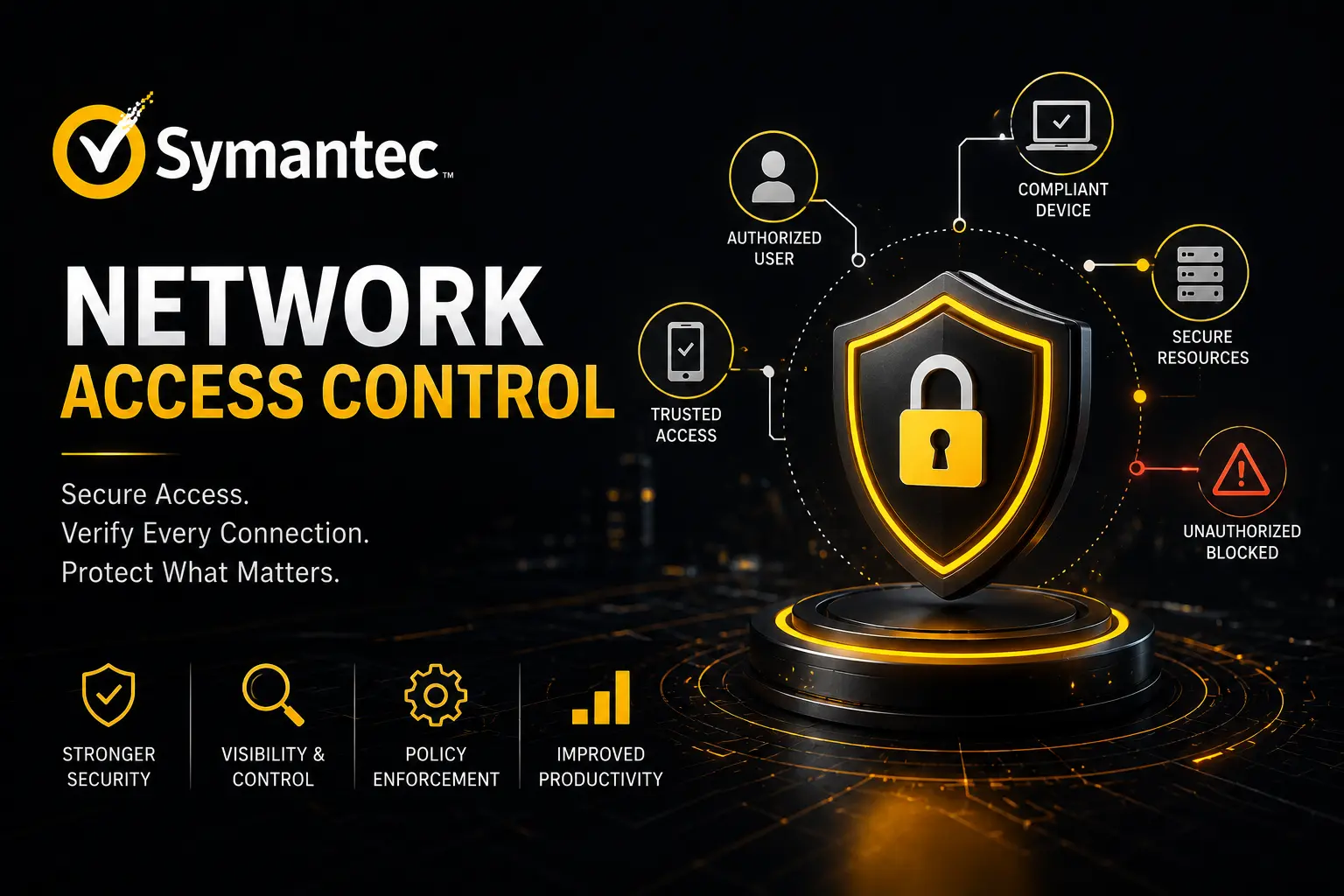
Symantec Network Access Control (SNAC) was a security solution that enabled organizations to manage access to their network. It confirmed device compliance, implemented security policies and denied access to devices that didn’t pass security checks. The product is no longer in production, but the ideas are still relevant today in today’s world of cyber security.
What Is Symantec Network Access Control?
Symantec Network Access Control was a Network Access Control (NAC) platform created by Symantec to help guarantee that only trusted and compliant devices can access corporate networks.
The solution included a check for endpoints prior to granting network access. If a device did not meet security requirements (e.g., did not have up-to-date security patches or anti-virus software), access might be restricted or remediation might be taken.
It functioned much like a security guard at the door of a company’s network, in simple terms.
Core Purpose of SNAC
Symantec Network Access Control’s main objectives were:
- Ensure that endpoints meet security standards.Confirm endpoint security adherence.
- Control network access
- Reduce security risks
- Automate remediation processes
- Support regulatory compliance
These features enabled organizations to have a healthy and secure network.
How Did Symantec Network Access Control Work?
The platform worked in a multi-step fashion.
1. Device Discovery
A device was found and evaluated when it tried to connect to SNAC.
2. Security Assessment
The system verified if the device conforms to the organizational security policies.
Common checks included:
- Antivirus status
- Firewall configuration
- Operating system updates
- Security patch levels
- Endpoint Protection compliance
3. Access Decision
On the basis of the findings of the assessment, the platform could:
Device Status | Network Access |
Fully Compliant | Full Access |
Partially Compliant | Limited Access |
Non-Compliant | Quarantine or Blocked |
4. Automated Remediation
Before accessing full network access, users might be asked to update software applications, apply security patches or correct security settings.
Key Features of Symantec Network Access Control
Endpoint Compliance Enforcement
The most beneficial thing was endpoint compliance validation. Prior to and throughout network penetration, the system would continuously check to ensure that devices fulfill corporate security requirements.
Host Integrity Checking
Host Integrity technology analyzed the security status of endpoints and made sure that they conform to policies.
It was an important feature later because Symantec stated that Host Integrity would remain a part of other security products following retirement.
Automated Policy Enforcement
Security administrators could establish policies and consistently enforce them throughout the network.
Examples included:
- Antivirus requirements
- Operating system requirements
- Approved software lists
- Firewall policies
Integration With Existing Infrastructure
One of the biggest advantages of SNAC was the fact that it could integrate with the current networking infrastructure and security setup, minimizing the complexity of deployment.
Why Was Symantec Network Access Control Important?
In the era before cloud computing and remote workers, strong perimeter security was a must for traditional corporate networks.
SNAC supported these organizations with a number of common challenges, including:
Managing BYOD Devices
Employees started bringing their personal laptop computers and mobile technology to the office and organizations had to know that the device was secure before granting access.
Reducing Malware Risks
Malware can be transmitted throughout the internal network via compromised devices. Preventing infected systems from getting in with the help of NAC solutions.
Meeting Compliance Requirements
There are regulations in many industries that need to be adhered to in terms of network security and access controls. By imposing security requirements, NAC solutions contributed to these compliance efforts.
Why Was Symantec Network Access Control Discontinued?
In 2014 Symantec officially declared Symantec Network Access Control End of Life (EOL). Support has been ongoing until November 2017.
There were a number of reasons for this.
Growth of Built-In Network Access Controls
Many networking vendors started integrating NAC into their switches, wireless controllers and security appliances.
Rise of BYOD and Mobility
Organizations had to adapt to mobile device usage, which revolutionized the way network security was handled.
Shift Toward Endpoint Security
Symantec shifted its focus to endpoint protection and advanced threat prevention technologies. Symantec Endpoint Protection (SEP) was enhanced with some Host Integrity functionality.
What Replaced Symantec Network Access Control?
Since SNAC retired, cyber security has come a long way.
Today’s organizations often use a combination of:
Zero Trust Network Access (ZTNA)
The motto of ZTNA is “Never Trust, Always Verify.
All access requests are continually authenticated rather than being trusted based on users being inside a network.
Today’s Symantec security products focus on Zero Trust Network Access as part of a larger Security Service Edge (SSE) product.
Security Service Edge (SSE)
SSE combines:
- Secure Web Gateway (SWG)
- Zero Trust Network Access
- Cloud Access Security Broker (CASB): A security platform designed to manage cloud services.
- Data Loss Prevention (DLP)
This design is becoming more popular than the traditional network-centric security systems.
Endpoint Detection and Response (EDR)
Today’s security solution continuously analyzes endpoint activity, not just when they connect to the network.
Symantec Network Access Control vs Zero Trust
Feature | Symantec Network Access Control | Zero Trust Network Access |
Focus | Device Compliance | Identity and Context |
Access Model | Network-Based | Application-Based |
Verification | Connection Time | Continuous |
Architecture | Traditional Network | Cloud-Friendly |
Remote Work Support | Limited | Strong |
While SNAC was effective for its time, Zero Trust models better support today’s cloud-first and remote-work environments.
Is Symantec Network Access Control Still Available?
No.
Symantec Network Access Control has not been sold since, and it was discontinued years ago. Organizations who are still on legacy deployments should look at moving to more modern deployments that can support Zero Trust principles, cloud applications, and hybrid work.
Common Use Cases SNAC Solved
Organizations used to have a lot of activities on the platform, including:
- Corporate LAN security
- Guest network management
- Endpoint compliance enforcement
- Malware prevention
- Employee device validation
- Regulatory compliance initiatives
The use cases are still applicable today, but are increasingly solved with more modern technologies.
FAQs
What was Symantec Network Access Control used for?
It was used to ensure that devices were secure, they were compliant with certain endpoint policies, and they were not allowed to connect to the corporate network.
Is Symantec Network Access Control still supported?
As per Symantec’s End of Life announcement, it is no longer supported by the vendor in November 2017.
What does NAC stand for?
Network Access Control (NAC): A security strategy that can be used to check if a device is secure enough to connect to a network.
Why did Symantec discontinue SNAC?
The company said, “Security trends, BYOD, and built-in NAC functionality from network vendors are driving change.
What replaced Symantec Network Access Control?
Some modern solutions involve Zero Trust Network Access (ZTNA), Security Service Edge (SSE), Endpoint Detection and Response (EDR), and integrated network security platforms.
What was Host Integrity in SNAC?
Host Integrity was a feature that would assess whether or not a host was secure and compliant before allowing it to access the network.
Is NAC still relevant today?
Yes. The idea has continued to be relevant, but contemporary organizations are applying the tenets of NAC in a variety of other ways, such as Zero Trust architectures and identity-based security measures.
How does Zero Trust differ from traditional NAC?
Traditional NAC is device-centric and network-centric, while Zero Trust is continuously validating users, devices and applications, no matter where they are.
Can small businesses benefit from NAC technologies?
Yes. Controlling access to business resources and endpoint compliance can be of benefit to organisations of all sizes.
What industries commonly use access control solutions?
Access control systems are commonly employed in access control applications to enhance security and compliance in healthcare, financial services, government, educational, manufacturing and enterprise environments.
Conclusion
Symantec Network Access Control was a critical security solution for organizations to verify compliance and control access to the network. It was years ago since the product was End of Life, but the principles are still relevant in today’s cyber security world. In today’s world, organizations are able to achieve the same objectives with Zero Trust Network Access, Security Service Edge platforms and sophisticated endpoint security solutions. Most businesses will have greater protection, better cloud compatibility, and better support for hybrid work environments when they implement a modern Zero Trust approach.