

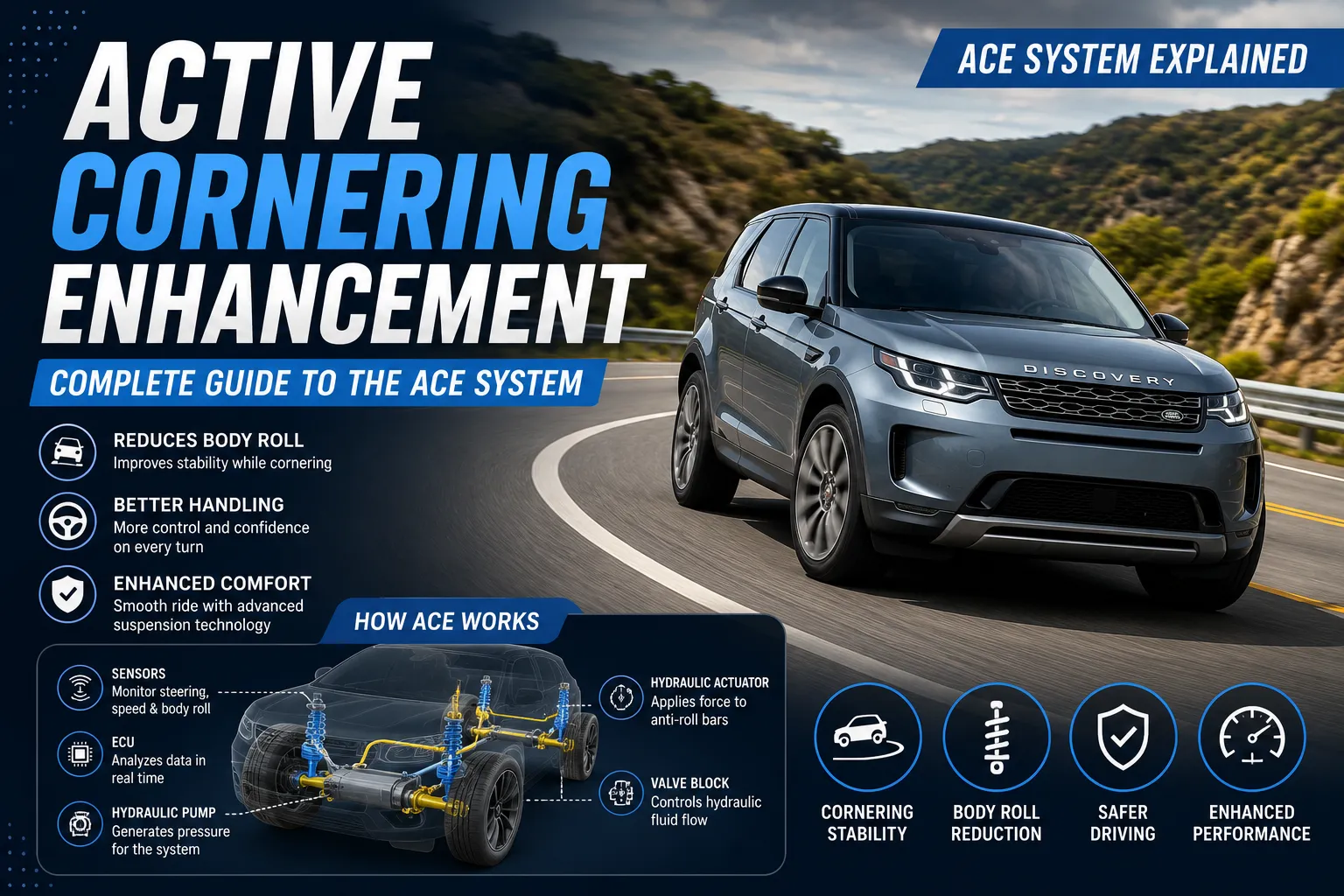
Active Cornering Enhancement: Quick Answer
Active Cornering Enhancement (ACE) is a sophisticated suspension system that helps to minimize body roll on corners. The ACE system is not just a traditional anti-roll bar system, but a system of hydraulic components, sensors, and an electronic control module that works to enhance the stability, handling, and passenger comfort of the vehicle.
It is perhaps most famous for its implementation in Land Rover cars, helping drivers to be more in control when driving on roads and when driving on land.
What Is Active Cornering Enhancement?
Active Cornering Enhancement, often shortened to ACE, is a dynamic suspension control system that automatically adjusts the stiffness of the vehicle’s anti-roll bars while driving.
Traditional suspensions feature an anti-roll bar with constant resistance, no matter the circumstances. The ACE system, on the other hand, monitors the way the vehicle moves at all times, and applies hydraulic pressure only if further help is required when it comes to roll control.
This will enable the suspension to stay comfortable when driving on the road, but become firmer when driving through corners.
The result is:
- Reduced body roll
- Better steering response
- Improved road grip
- Greater passenger comfort
- Increased driving confidence
Since the system processes the information on-the-fly, the driver might find the ride to be smoother in corners while maintaining the ride characteristics.
How Does the ACE System Work?
The Active Cornering Enhancement system is constantly gathering data from several vehicle-mounted sensors.
These sensors monitor:
- Steering angle
- Vehicle speed
- Lateral acceleration
- Suspension movement
- Body roll
This information is transferred to the electronic control module, which works out the answer within milliseconds.
If the car is starting to roll in when turning, the hydraulic actuators compress the anti-roll bars, which minimises body movement and helps to keep the vehicle level.
After the turn, the pressure in the hydraulic system is lowered and the suspension comes back to its more comfortable setting.
This allows the ACE system to respond to the conditions much more quickly than traditional suspension designs.
Components of an Active Cornering Enhancement System
The Active Cornering Enhancement system is made up of a few key elements that work in concert to provide enhanced performance.
Hydraulic Pump
The ACE system uses a hydraulic pump that creates the pressure needed for it to function. It is impossible to actively control body roll without having enough hydraulic pressure.
Valve Block
The valve block is what controls the flow of hydraulic fluid between various components in the system, and it sends the fluid where it is most needed when cornering.
Sensors
There are several electronic sensors constantly monitoring the dynamics of the vehicle, such as steering torque, speed and body movements.
These sensors feed the real-time data back to the control module to make quick changes.
Electronic Control Module (ECM)
The ECM is the control unit of the ACE system. It compares data gathered from the sensors and calculates the degree of hydraulic pressure to be applied in each driving situation.
Hydraulic Actuators
The hydraulic actuators make direct contact with the anti-roll bars to enhance stability on corners with a comfortable ride on straight roads.
Benefits of Active Cornering Enhancement
This Active Cornering Enhancement system has several benefits over traditional suspension designs, especially for larger SUVs with more body motion as they turn corners.
Reduced Body Roll
The greatest advantage of the ACE system is that it reduces body roll when cornering. The vehicle’s anti-roll bars are actively controlled to ensure improved stability and ride comfort in corners.
Improved Handling
The steering is more precise and predictable with less body movement. Drivers tend to be more confident when cornering at speed or in curvy roads.
Better Road Grip
A more level ride will provide better traction and overall handling as the tires will have more contact with the road surface.
Increased Passenger Comfort
Active Cornering Enhancement only adds more roll control when it is needed, as opposed to conventional passive suspension systems. Suspension feels comfortable during normal driving, but maintains stability.
Enhanced Off-Road Performance
One of the reasons for using the ACE system was that it was able to perform on-road and off-road driving. It provides more flex in the suspension when driving over rough roads whilst maintaining excellent handling on packed roads.
Common ACE Problems
Though very effective, the Active Cornering Enhancement system can suffer problems over time from a variety of hydraulic and electronic components.
Some of the most common problems include:
Hydraulic Fluid Leaks
Over time, hydraulic hoses, seals and/or actuators can leak, which decreases the pressure in the system and impacts performance.
Faulty Sensors
The reliance on the sensors means that if they become damaged or inaccurate, the system can make the wrong adjustments to the suspension.
Hydraulic Pump Failure
Under driving conditions, the hydraulic pump runs at all time. Increased mileage can lead to a decrease in pressure or failure of the pump.
Valve Block Issues
Internal valve block issues may limit hydraulic flow and result in poor body roll control and/or warning messages.
Electronic Module Faults
Many of today’s vehicle systems can trigger the ACE warning light due to software or electrical issues in the control module.
With the regular maintenance and early diagnosis, minor problems can often be avoided into costly repairs.
ACE Warning Light Explained
Should the ACE warning light come on in the dashboard the system has identified a fault that needs to be checked.
Common causes include:
- Low hydraulic fluid
- Pressure loss
- Sensor malfunction
- Hydraulic pump failure
- Valve block problems
- Electrical wiring faults
The car can still be driven, but may have decreased stability and handling. The problem is usually best diagnosed as early as possible, to prevent further damage.
Which Vehicles Use Active Cornering Enhancement?
The Active Cornering Enhancement system is a feature that’s often found in Land Rover vehicles.
Land Rover Discovery
The ACE system has been fitted to several generations of the Land Rover Discovery, especially those aimed at on/off-road comfort.
Range Rover
Some Range Rover and Range Rover Sport models also have Active Cornering Enhancement or other active suspension systems to improve handling without compromising on luxury ride quality.
Vehicle suspension technology has progressed over the years, and many of the new suspension systems are electronically controlled or adaptive, following the same principles of minimizing body roll and maintaining stability.
Maintenance Tips
The Active Cornering Enhancement system is maintained through regular inspection which helps to ensure efficient operation and can avoid expensive repairs.
To maximize the lifespan of the ACE system:
- Inspect hydraulic hoses regularly for leaks.
- Check hydraulic fluid levels during scheduled maintenance.
- Replace worn seals before they begin leaking.
- Scan for diagnostic fault codes if the ACE warning light appears.
- Follow the manufacturer’s recommended service schedule.
- Use only approved hydraulic fluids and replacement parts.
Since it is a hydraulic/electronic system, expert diagnosis is generally recommended if a fault occurs.
Frequently Asked Questions
What is Active Cornering Enhancement?
Active Cornering Enhancement (ACE) is a hydraulic suspension system developed to actively control the body roll when cornering by adjusting the anti-roll bars in real time.
Which vehicles use Active Cornering Enhancement?
It’s usually seen in the selected Land Rover official Discovery, Range Rover and Range Rover Sport models.
Is Active Cornering Enhancement the same as air suspension?
No. Air suspension, on the one hand, will adjust ride height and ride comfort, while on the other hand, A.C.E. is targeting to reduce body roll and enhance the sportiness of the car during cornering. A combination of both may be employed on some vehicles.
Can I drive with the ACE warning light on?
Handling may be affected but the vehicle may still be driven in many cases. The system should be inspected as soon as possible, to avoid any further damage.
Is the ACE system expensive to repair?
The cost of the repairs depend on which component has failed. Therefore, the cost of a hydraulic pump, valve block, sensors and actuators is typically higher than the cost of other routine maintenance products, and early diagnosis is crucial.
Final Verdict
Active Cornering Enhancement is still one of the most sophisticated hydraulic suspension upgrades created to enhance the handling of an SUV. The ACE system continually checks steering input, vehicle speed and body movements to reduce body roll without compromising ride comfort.
The system is most famous for its employment by Land Rover vehicles, but its concepts have also been adopted by numerous suspension systems for other current cars. If properly maintained and repaired, Active Cornering Enhancement can greatly enhance confidence and overall vehicle stability.
If you are interested in the cutting-edge in transportation, automotive technology, automotive engineering and other automotive innovations, the homepage of TechBizInsider offers practical guides on various modern vehicle systems and emerging technologies on a regular basis.