
Introduction
Artificial intelligence is no longer a concept from science fiction movies. It is in your phone, your car, your email inbox, and your doctor’s office. However, few people can explain what it is or how it functions.
Artificial Intelligence (AI) is the capacity of machines to execute tasks traditionally handled by human beings, which involve reasoning or learning from observation. One of the most defining technologies of our time and knowing about it has become a life skill.
This guide explains everything from what AI is, how it functions, various forms and applications, and what its future holds.
What Is Artificial Intelligence?
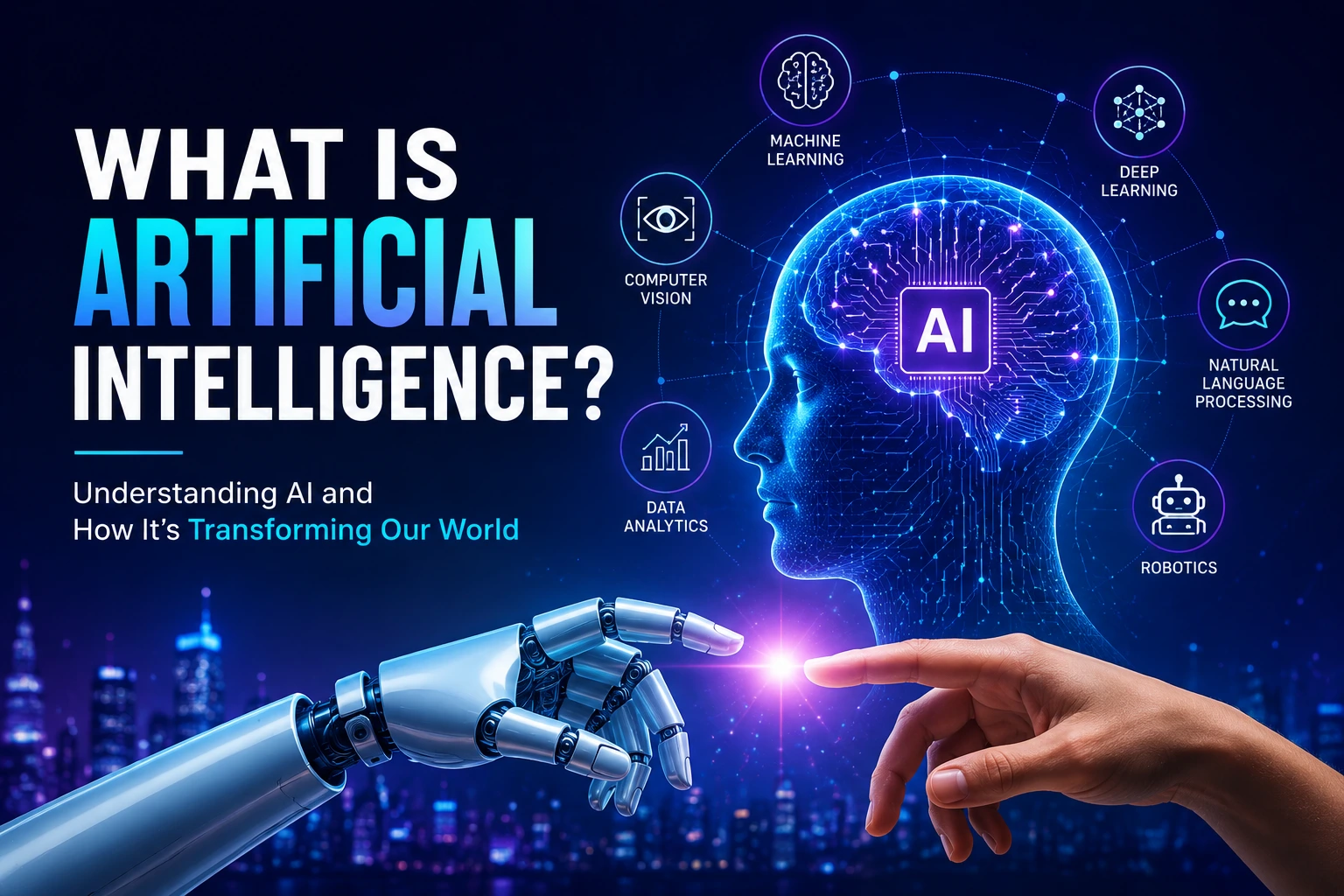
Artificial Intelligence is the technology which allows computers and machines to imitate a human’s learning, understanding, problem-solving, decision-making, creativity, and autonomy.
In other words, how AI can help machines learn to perform tasks that are more easily accomplished by humans, such as understanding language, recognising patterns, solving problems, and adapting to new information.
AI is an area of computer science that focuses on developing intelligent machines, such as those capable of learning and reasoning.AI is an area of computer science that focuses on the development of intelligent machines, including those that can learn and reason. AI systems can use large datasets to draw patterns and make predictions or decisions without being programmed for all cases.
The idea is not an original one. The concept of “a machine that thinks” was discussed for the first time in 1950 by Alan Turing. However, the true spurt in AI has come in the past decade, driven by a massive rise in computing power and access to vast quantities of data.
How Does Artificial Intelligence Work?
AI doesn’t think like humans. Rather it acquires vast amounts of data and learns patterns or trends in the data, and predicts or acts on the basis of those patterns.
Machine learning (ML), which is one of the core pillars of AI, is the technology that allows machines to learn from data and make improvements as they acquire more experience. Deep learning, which relies on neural networks and is able to glean meaning from vast amounts of unstructured data, is the basis of most of today’s AI solutions, and it lies beneath machine learning.
Here’s a basic description of the core layers:
- Artificial Intelligence: this is the general term used for machines that emulate human intelligence.
- Machine Learning: algorithms that learn from data to make predictions
- Deep Learning: a type of machine learning using layered neural networks
- Generative AI: The newer variant of generative AI, known as generative AI, generates original content such as text, images, video and more.
This is linked to the layer below it. Generative AI products, such as ChatGPT and image generators, are based on deep learning models that have been trained on billions of examples.
Types of Artificial Intelligence
Understand the various forms of Artificial Intelligence.Know about the different kinds of AI.
Not all AI is the same. AI systems can be classified according to their functionality and the way they work.
By Capability
Today, the only type of AI that exists is Artificial Narrow Intelligence (ANI). ANI models are created to execute one of the particular functions, like identifying photos, chatting, or filtering e-mail. These can range from voice assistants to facial recognition and big language models such as Gemini and GPT-4.
Artificial General Intelligence (AGI) is a future concept in AI where an AI system has the capability to perform or execute any task at par with that of a human. It is still hypothetical, and there is a lot of disagreement among experts about the when, and if, it comes.
Artificial Superintelligence (ASI) is a theoretical breakthrough that goes beyond AGI, in which an AI system would perform much better than a human in all areas.Artificial Superintelligence (ASI) is a hypothetical leap that is beyond AGI, in which an AI will be able to outperform a human in all fields.
By Memory and Learning Style
AI can also be classified based on the way it processes the information: Reactive Machines are limited to only reacting to a certain input, such as the IBM’s Deep Blue chess program, which had no memory. Limited Memory systems learn from previous experiences to make future decisions, that’s what most of today’s AI, such as self-driving cars, do. Both are in development: Theory of Mind AI will be able to know how people feel and what they are thinking, and Self-Aware AI is completely theoretical.
What Is an Agent in Artificial Intelligence?
AI agents are one of the most current and rapidly emerging concepts in the tech industry today, and it’s essential to grasp this idea properly.
Artificial Intelligence Agent: A software agent that is able to communicate with its environment, gather information, and use the information to autonomously carry out behavior to achieve a set goal. Humans set up goals, but an AI agent selects the best action(s) to take to accomplish the goals independently.
It’s like your assistant does not just answer questions, it’s an assistant that is finding things out. For instance, a customer service AI agent won’t only reply to messages, but also identify the problem, search for relevant data, implement a solution, and follow up on the situation, without any human intervention.
The key is that AI agents repeat the following steps over and over again: Perception (read the data), Reasoning (analyze the data), Planning (break down the goal into steps), Action (take steps through tools), and Learning (adjust based on results).
62% of organizations are already implementing AI agents, according to McKinsey. By 2026, Gartner believes that task-specific AI agents will be included in 40% of enterprise applications, a significant increase from less than 5% in 2025.
What Is the IQ of Artificial Intelligence?
This is actually a surprisingly common question, and the truth is a bit complicated.
In 2017, researchers conducted intelligence tests on publicly available AI systems like Google AI and Siri. These systems were able to obtain an IQ of up to approximately 47, or the cognitive level of a first-grade child. In 2014 similar tests were conducted with an average IQ of 27.
That’s just the thing, though, that’s a very incomplete perspective. Today’s AI models, such as GPT-4 and Google Gemini, are much better on many cognitive tests. AI’s performance on the advanced benchmarks, such as GPQA (which tests graduate-level reasoning) and SWE-bench (which tests software engineering tasks), improved by 48.9 percentage points and 67.3 percentage points, respectively, between 2023 and 2024.
The difference is that the AI is better than humans at well-defined tasks, but not as malleable. It is above human in restricted areas and below human in others. Nobody would use a one-size-fits-all metric to measure a horse’s intelligence, like the amount of crap it can spit out, so why would anyone use a single number to evaluate the intelligence of an AI?
What Is an Artificial Intelligence Consultant?
AI has become a key part of a business’s strategy, and a new role has come into existence, the AI consultant.
An AI consultant is a professional who assists organisations in comprehending, implementing and improving AI technologies. They usually perform activities such as:
- Identifying areas of value creation in a business with AI
- Suggesting the appropriate tools, platforms or bespoke AI solutions
- Ensuring implementation and integration with systems in place
- Providing guidance on ethical practices, data privacy, and compliance with regulations.Counselling ethical practices, data privacy and regulations.
- Developing teams to effectively collaborate with AI tools.Building teams to function effectively with AI tools.
McKinsey’s study of organizations in 105 countries found that almost 9 out of 10 organizations report using AI on a regular basis, but the vast majority are not yet fully integrated to benefit the enterprise. That’s where AI consultants come in handy.
AI consultants can have backgrounds in data science, software engineering, business strategy, or industry-specific fields, such as healthcare or finance. As companies have begun to understand that AI deployment isn’t a software purchase, but rather involves more than just that, the need for this role is increasing rapidly.
What Is the Best Artificial Intelligence App?
It really depends on your objectives. Let’s start with a breakdown, by use case:
As a baseline for conversation and writing, ChatGPT (OpenAI), Claude (Anthropic), and Gemini (Google) are the most popular choices. They all have unique capabilities in terms of reasoning, style and tool integration.
In terms of image generation: Midjourney, Adobe Firefly, and DALL-E 3 are popular tools for producing visual content based on textual prompts.
To assist developers in coding: GitHub Copilot and Claude Code provide real-time code suggestions and complete project management.
To boost productivity and research: Perplexity AI acts as an AI-powered search engine and AI tools like Notion AI and Microsoft Copilot are built to be used in daily work.
When it comes to voice interaction, Siri from Apple, Amazon Alexa, and Google Assistant are the most user-friendly voice-controlled AI solutions available.
The best app is situational. In the U.S., ChatGPT and Claude provide the best combination of writing, research, coding, and conversation for most consumers.
What Is the Opposite of Artificial Intelligence?
The phrase “opposite of artificial intelligence” is used in a few different ways, and understanding them helps clarify what AI actually is.
Natural Intelligence is the most direct conceptual opposite — the intelligence that living organisms, especially humans, possess naturally through biological processes. It includes intuition, emotional understanding, consciousness, and the ability to learn from open-ended experience.
Human Intelligence is often contrasted with AI in discussions about automation and the workforce. Where AI excels at speed, scale, and consistency, human intelligence excels at empathy, creativity, ethical judgment, and navigating ambiguous social situations.
Unintelligent or rule-based systems — traditional software that follows fixed instructions without any learning capability — could also be considered the functional opposite of AI.
The contrast is not always about superiority. AI works best as a tool: doing its strongest work by processing large amounts of data and uncovering patterns that may not be obvious to humans, while still requiring human oversight to be truly effective.
Real-World Applications of AI
AI is not theoretical. It is already reshaping industries across the US and globally:
Healthcare: AI assists in diagnosing diseases, analyzing medical imaging, predicting patient outcomes, and accelerating drug discovery.
Finance: Fraud detection, algorithmic trading, credit risk assessment, and personalized financial advice all rely on machine learning models.
Retail and e-commerce: Recommendation engines, dynamic pricing, inventory management, and customer service chatbots run on AI.
Transportation: Self-driving vehicle technology, traffic optimization, and logistics routing all depend on AI systems.
Education: AI has moved from promise to practice in education — empowering faculty with real-time insights, helping students personalize their learning journeys, and driving measurable outcomes.
Benefits and Challenges of AI
Key Benefits:
The top five benefits of AI are better decision making, better operational efficiency, better customer experiences, automating repetitive tasks, and forecasting trends and behaviors from data analysis.
Challenges to Consider:
- Bias: When training AI systems with biased data can result in biased or discriminatory outputs.
- Job displacement: Automation impacts some jobs and workforce reskilling is needed.
- Data privacy: AI systems need a vast amount of data but pose concerns about the use of personal information
- Transparency: Many AI models are “black boxes” and decisions they make are difficult to explain or audit.
- Ethical AI The ethical considerations of AI are increasingly important, with ongoing research aimed at creating explainable AI methods, mitigating biases, and ensuring compliance with data privacy regulations.
The Future of Artificial Intelligence
Agentic AI is the next big step in the evolution of AI, involving AI systems that can fragment tasks into neat, actionable steps and execute them on a user’s behalf. This is not about answering the questions, but about setting goals end to end.
In 2024, $109.1 billion was invested in AI in the US, and first-half AI infrastructure investment increased by over 20%.
The path is obvious: AI will be better, bolder, and more agentive. They will have a big edge over those who know it and know how to use it wisely.
Conclusion
Artificial Intelligence is the technology of today’s age. Whether it is through the voice assistant on your cell phone or the algorithms driving medicine, finance or education, AI is transforming the way humans interact with information and with the world.
It is no longer a choice but a necessity to use AI’s capabilities and understand its limitations in order to live in the digital age. This guide equips you with the building blocks to communicate and have confidence in AI, whether you’re a business owner, student, professional, or a curious individual.
The technology will continue to be developed. The key is to be informed, think critically, and keep in mind that AI is a tool and like any tool, it functions best when used with care.
Frequently Asked Questions
Q1: What is artificial intelligence in simple terms?
Artificial Intelligence is nothing but the intelligence of machines. AI refers to any type of technology that enables computers to accomplish tasks that typically require human cognitive effort, such as reading text, identifying faces, and making decisions.
Q2: What is the difference between AI and machine learning?
The general term for thinking machines is AI. One way to do that is through machine learning — algorithms that are trained on data, learning and improving from it.
Q3: What is an agent in artificial intelligence?
An AI agent acts in order to achieve a desired objective without having to be directed at each step. It senses, thinks, and moves, independently.
Q4: What is the IQ of artificial intelligence?
Early AI systems had an IQ score of ~27-47. Today’s models achieve significantly better results on certain benchmarks, but artificial intelligence has yet to keep pace with humans’ ability to adjust their performance in various scenarios.
Q5: What does an artificial intelligence consultant do?
They assist companies in determining the proper fit, selecting the right tools, implementing the rollout, and training teams on the appropriate usage of AI.
Q6: What is the opposite of artificial intelligence?
The intelligence that is natural, emotional, intuitive and practical — the kind that comes from experience. The other being rule-based software, which does not learn.
Q7: What is the best AI app for everyday use?
For most of our daily needs, ChatGPT and Claude will do our work. The best use of GitHub Copilot is to write code. Voice tasks: Siri, Alexa and Google Assistant come in handy.
Q8: Is artificial intelligence dangerous?
It poses a genuine threat – bias, privacy issues and abuse. Responsible design and careful management, however, make it manageable – but not necessarily dangerous, most experts agree.