
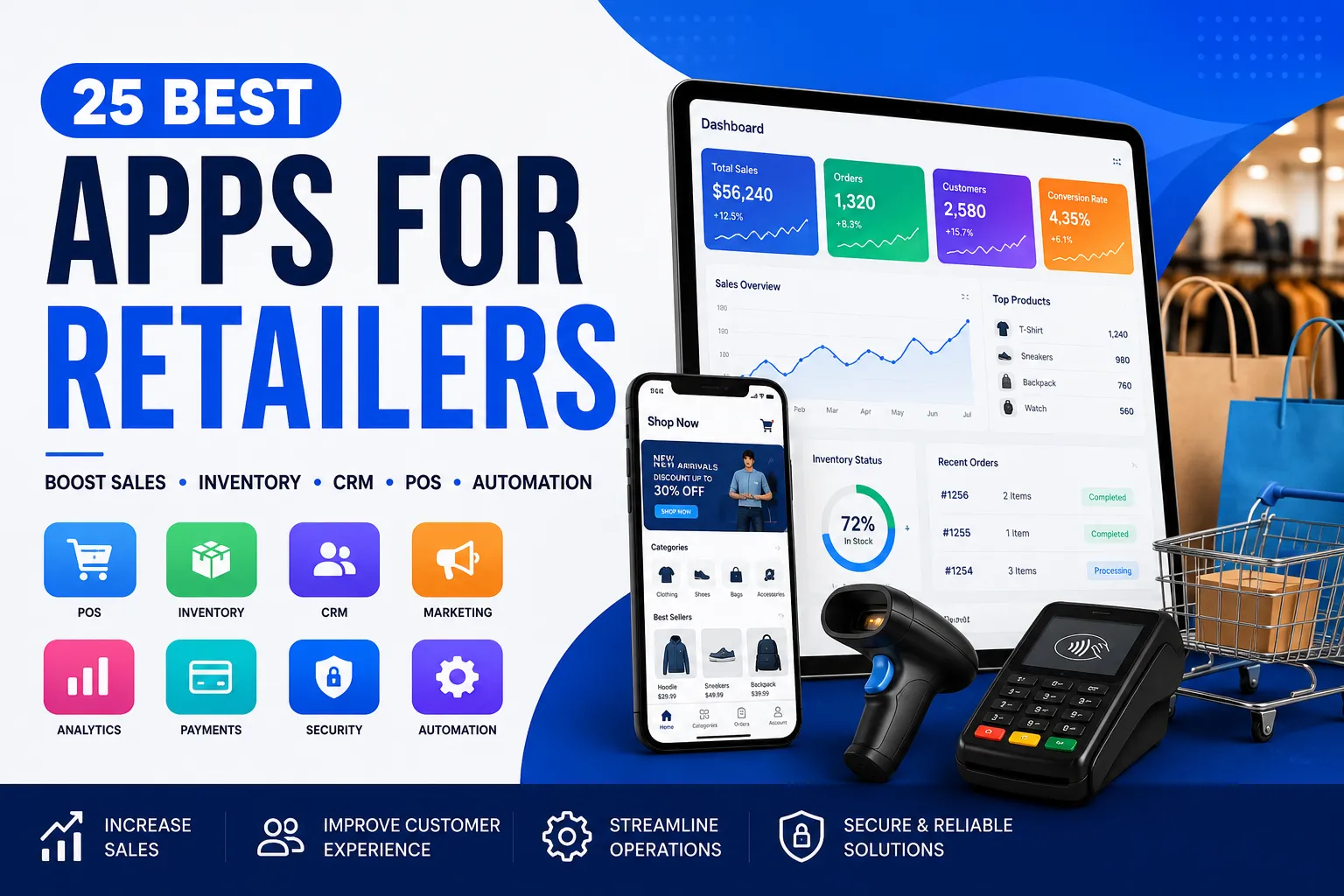
Apps For Retailers: Quick Answer
The top Apps For Retailers enable companies to manage stock, take safe payments, enhance customer relationships, automate marketing, and boost total sales. From small boutique to multi-location retail, the right retail apps can save you time and enhance the shopping experience.
Today’s retailers commonly rely on apps for:
- Point of Sale (POS)
- Inventory management
- Customer Relationship Management (CRM)
- Employee scheduling
- Payment processing
- Marketing automation
- Digital signage
- Analytics and reporting
Retailers can save time, lower operating expenses and make better business decisions by integrating several business functions into one workflow.
Why Apps Matter for Modern Retail Businesses
Retail has changed dramatically over the past few years. Today’s shoppers want quick checkout, customized recommendations, e-commerce ordering and multi-channel communication.
Modern Apps For Retailers make these expectations easier to meet.
Increase Sales Faster
Personalized promotions, loyalty programs, digital coupons, and mobile shopping experiences are some of the ways retail apps can boost conversions.
Retailers can reach customers via mobile notifications and online ordering, as well as in-store sales.
Improve Customer Experience
Customers appreciate businesses that offer:
- Faster checkout
- Digital receipts
- Mobile payments
- Loyalty rewards
- Personalized recommendations
A well-designed retail app improves convenience while encouraging repeat purchases.
Automate Daily Operations
Many repetitive tasks can now be automated, including:
- Inventory updates
- Appointment scheduling
- Order management
- Customer notifications
- Sales reporting
- Staff scheduling
Business owners can devote more time and effort to business growth, not paperwork, when they automate.
Make Better Business Decisions
Retail analytics dashboards offer useful information on:
- Best-selling products
- Peak shopping hours
- Customer purchasing behavior
- Inventory turnover
- Revenue trends
These insights enable retailers to fine-tune their pricing, marketing strategies, and inventory management.
If you’re interested in business automation, explore our guides on Droven.io AI Automation Tools and Advocate AI to see how AI is improving retail operations.
Essential Types of Apps Every Retailer Needs
It’s important to know the different categories of retail software before deciding on a specific application.
POS Apps
Point-of-sale applications enable retailers to process payments, handle sales, print receipts and monitor transactions from a cell phone, tablet, or desktop computer.
Some of the most popular are Square POS, Shopify POS, and Lightspeed Retail.
Inventory Management Apps
Inventory software helps businesses:
- Monitor stock levels
- Receive low-stock alerts
- Track product movement
- Generate purchase orders
- Reduce inventory losses
Proper inventory control will help to avoid stock-outs and boost profitability.
CRM Apps
CRM software allows retailers to keep track of customer data, sales history, and automate marketing efforts.
Good CRM can also help to create customer loyalty by providing personalized shopping experiences.
Payment Apps
Modern payment platforms support:
- Credit cards
- Debit cards
- Apple Pay
- Google Pay
- PayPal
- Contactless payments
Secure payment processing improves both customer trust and checkout speed.
Marketing Apps
Marketing applications can assist retailers in the following ways:
- Schedule social media posts
- Send email campaigns
- Create promotions
- Manage customer reviews
- Track advertising performance
These tools help you to attract new customers and keep the old ones.
25 Best Apps For Retailers
Here are some of the most trusted Apps For Retailers, sorted by business function to help you decide which one is best for your store.
1. Shopify POS
Best for: Omnichannel retail stores
Shopify POS combines online and in-store sales into one platform. Retailers can manage products, inventory, customer profiles, and payments from a single dashboard.
Key Features
- POS system
- Inventory management
- Customer profiles
- Mobile checkout
- Analytics
2. Square POS
Best for: Small businesses
One of the most convenient POS systems for the retailers who are starting a new business is Square. It enables contactless payments, inventory management, staff management, and customer loyalty initiatives.
3. Lightspeed Retail
Best for: Multi-location stores
For expanding retailers, Lightspeed provides a range of advanced inventory management, supplier management, purchase order and reporting features.
4. HubSpot CRM
Best for: Customer management
Email marketing and sales automation make it easier for retailers to organize customer information, automate follow-ups, and foster better customer relationships with HubSpot.
5. Zoho CRM
Best for: Growing retail businesses
Zoho CRM includes sales automation, customer segmentation, workflow automation, and reporting tools at an affordable price.
6. Mailchimp
Mailchimp is a tool for retailers to build email campaigns, promotions, abandoned cart emails, and customer newsletters.
7. Canva
Retailers can use Canva to design social media graphics, promotional posters, product catalogs, and marketing materials without having to be a professional designer.
8. Meta Business Suite
Retailers can manage Facebook and Instagram pages, schedule posts, respond to customer messages, and monitor advertising performance from one dashboard.
9. Slack
Slack enhances communication between retail teams, allowing them to coordinate inventory, promotions, customer service, and day-to-day operations more easily.
10. WhatsApp Business
Retailers leverage WhatsApp Business to communicate with customers regarding their orders, appointments, product inquiries, and support.
Top Rated Digital Sign Apps for Retail Use
One of the most effective ways to grab the attention of customers within retail stores is digital signage.
Some of the top rated digital sign apps for retail use include:
ScreenCloud
Perfect for posting promotions, menus, announcements and product advertising in several store locations.
Yodeck
A cloud-based digital signage solution that integrates images, videos, live dashboards and social media feeds.
OptiSigns
Ideal for retailers who want to control promotional displays from a central control panel, while updating content remotely.
NoviSign
Provides drag-and-drop templates, scheduling capabilities and support for interactive retail displays.
Using digital signage helps retailers:
- Promote seasonal offers
- Increase impulse purchases
- Reduce printed marketing costs
- Display real-time announcements
- Improve the in-store shopping experience
Retail research has demonstrated that digital signs can generate a much higher level of customer interaction than traditional printed signage.
Learn how automation is transforming modern businesses in our article on AI Automation Tools.
Boost Retail App for iPhone
If you have looked for the Boost Retail App for iPhone, you will know that retailers are searching for mobile apps that make it easier to run their stores while out and about.
A quality iPhone retail app should include:
- Inventory management
- Sales tracking
- Customer profiles
- Mobile POS
- Order management
- Push notifications
- Business analytics
Accessing your business on mobile means you can keep an eye on your business from anywhere, whether you’re using Shopify POS, Square or another retail platform.
What Are the Most Cost-Effective Tools for Building Retail Apps?
Many businesses eventually ask, what are the most cost-effective tools for building retail apps?
It depends on your budget, technical skills and long-term business objectives. Fortunately, there are modern development platforms that enable developers to create quality retail applications without spending hundreds of thousands of dollars.
Here are some of the most popular options:
Flutter
Flutter is a platform developed by Google that enables the creation of Android and iOS apps with a single code base. It has a great performance, fast development and a huge ecosystem of plugins.
React Native
Another popular cross-platform framework is React Native, which enables businesses to build mobile retail applications for both iPhone and Android, at a lower cost.
Firebase
One of the most popular backend solutions for retail applications is Firebase, which offers authentication, cloud storage, analytics, push notifications, and real-time databases.
Bubble
Bubble is a great option for startups and small businesses because it allows them to create retail applications without coding.
Shopify App Development
Existing Shopify retailers can expand their stores with custom apps which connect inventory, payments, loyalty programs, and customer management.
The platform you select will depend on your business size, needed features, and future scalability.
Data Security Tools for Retail App Development
Security is one of the most critical aspects of data security tools for retail app development.
Sensitive data such as payment information, addresses, order history, and personal information are commonly handled in retail applications. It is crucial to safeguard this information to ensure customer trust and adherence to privacy laws.
Some of the most widely used security tools include:
Firebase Authentication
Supplies safe sign-in approaches, for example, email, Google, Apple, cell phone confirmation, and others.
Auth0
Auth0 makes user authentication easy, and provides multi-factor authentication (MFA), passwordless login, and enterprise identity management.
Cloudflare
Cloudflare can help retail websites and APIs withstand DDoS attacks, malicious bots and performance problems, and enhance load time.
Stripe Security
Stripe’s PCI-compliant infrastructure is commonly used by retail apps that accept online payments, ensuring secure transactions.
OWASP Mobile Security Guidelines
The Open Worldwide Application Security Project (OWASP) has also published a set of recommendations for developers to minimize security vulnerabilities in mobile applications.
Future Trends in Retail Apps
Artificial Intelligence and automation will play a crucial role in the future of Apps For Retailers.
Some of the biggest trends include:
- AI-powered shopping assistants
- Personalized product recommendations
- Augmented Reality (AR) shopping
- Voice commerce
- Self-checkout technology
- Smart inventory forecasting
- Omnichannel customer experiences
- Mobile-first loyalty programs
Retailers that embrace these technologies will be better equipped to enhance customer satisfaction and stay competitive.
Interested in AI-powered business tools? Read our guides on Generative AI News, Advocate AI, and Droven.io AI Automation Tools to see how artificial intelligence is reshaping modern commerce.
Frequently Asked Questions
What are the best Apps For Retailers?
Top Apps For Retailers are Shopify POS, Square POS, Lightspeed Retail, HubSpot CRM, Zoho CRM, Mailchimp, Canva and Meta Business Suite. The selection will depend on your store size, budget and operational needs.
What are the top rated digital sign apps for retail use?
Some of the most popular top rated digital sign apps for retail are ScreenCloud, Yodeck, OptiSigns, and NoviSign. These platforms enable retailers to broadcast promotions, announcements, menus and digital ads to a single or multiple sites.
Is the Boost Retail App for iPhone worth using?
The Boost Retail App for iPhone may be helpful for retailers who want to keep track of inventory, sales and business information away from the store. Before choosing any retail app, companies should look for features and compatibility.
What are the most cost-effective tools for building retail apps?
Some of the most cost-effective tools for building retail apps include Flutter, React Native, Firebase, Bubble, and Shopify App Development because they reduce development time while supporting scalable applications.
Which data security tools are recommended for retail app development?
Essential data security tools for retail app development include Firebase Authentication, Auth0, Cloudflare, Stripe Security, and OWASP Mobile Security Guidelines to help protect customer information and payment data.
Final Verdict
The selection of Apps For Retailers can have a significant impact on the operation of a retail business. Today’s retail apps can streamline repetitive tasks and enhance customer experiences, from inventory management to CRM systems, payment processing to digital marketing.
Whether you’re searching for top rated digital sign apps for retail use, evaluating the Boost Retail App for iPhone, researching what are the most cost-effective tools for building retail apps, or exploring data security tools for retail app development, investing in reliable technology will help your business grow more efficiently and stay competitive in an increasingly digital retail environment.