

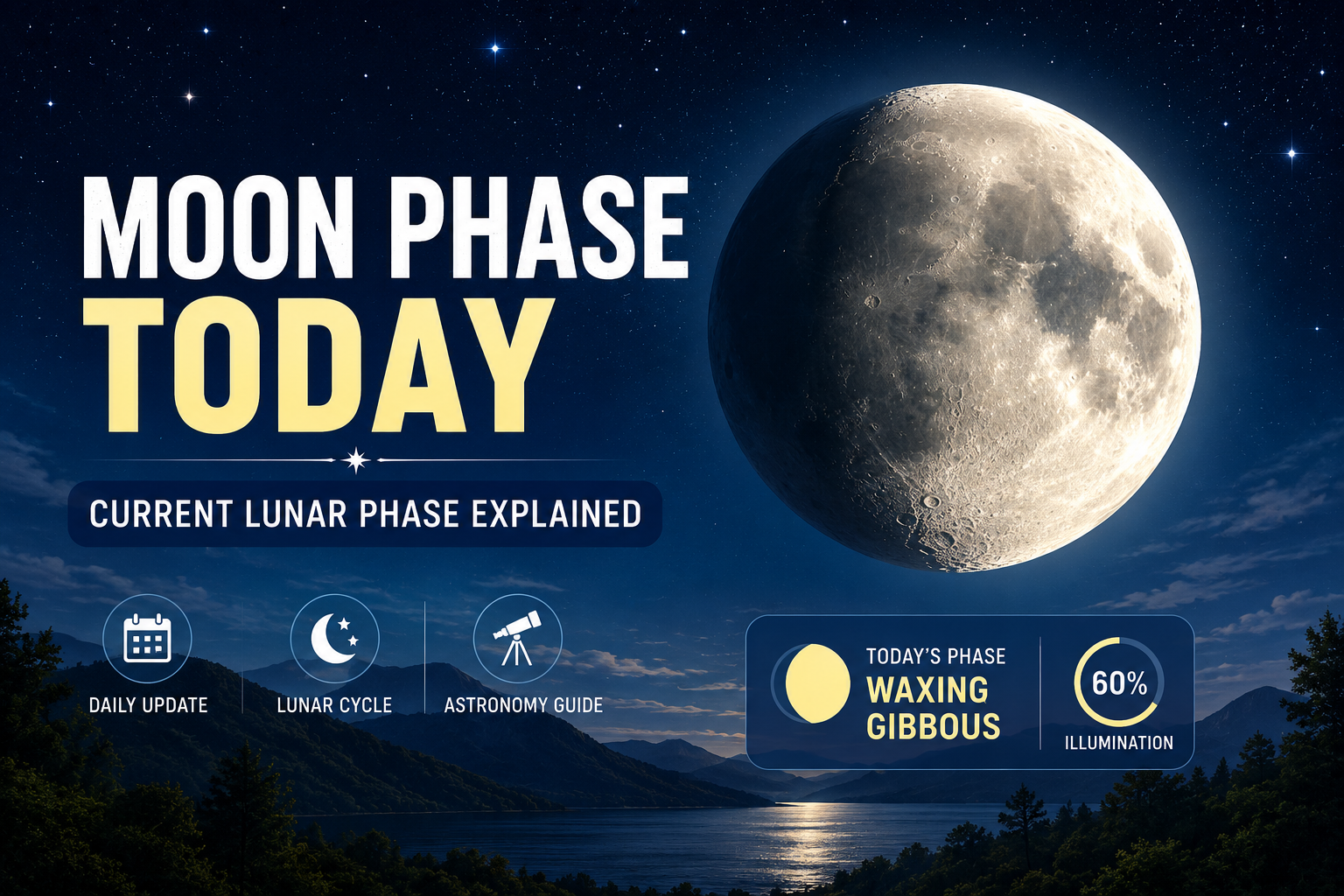
Moon Phase Today: Quick Answer
Today’s moon phase will vary based on the date and location. The Moon passes through a continuous lunar cycle of approximately 29.5 days and its appearance varies as it orbits the Earth. The changing angle of the Sun, Earth and Moon causes each phase, from a New Moon to a Full Moon and back.
For the exact phase for today, consult a reliable lunar calendar or astronomy app that is updated daily. The Moon’s illumination percentage, moonrise and moonset times, and the date of the next major lunar phase are also indicated on these sources.
What Does Today’s Moon Phase Mean?
The moon phase is the fraction of the sunlit portion of the Moon’s surface that can be seen from the Earth at a given moment. Although the Moon itself doesn’t change shape, the amount of its illuminated surface that we can see changes throughout the month.
The ongoing phase may impact activities like:
- Stargazing and astrophotography
- Planning night hikes
- Observing tides
- Learning about astronomy
- Following lunar calendars for cultural or religious events
Astronomers identify eight primary phases that repeat every lunar month.
The 8 Main Moon Phases
1. New Moon
The Moon is between the Earth and the Sun, and the lit side is away from the Earth. It’s generally not visible in the night sky.
2. Waxing Crescent
After the New Moon, a thin crescent starts to appear, and the illuminated part grows.
3. First Quarter
The visible surface of the Moon is about half lit. This phase is happening about a week after the New Moon.
4. Waxing Gibbous
As the Moon approaches the Full Moon, more than half of the Moon is illuminated.
5. Full Moon
The entire face of the Moon visible from the Earth is illuminated, so it is the brightest phase of the lunar cycle.
6. Waning Gibbous
Following the Full Moon, the lighted part starts to wane.
7. Last (Third) Quarter
The illumination of the Moon is 50% and it is visible on the other half, but on the other side of the Moon than the First Quarter.
8. Waning Crescent
Just a thin crescent is visible before it’s back to the New Moon.
If you enjoy science and technology topics, explore our guides on Android vs iOS Security, How to Use Meta AI, and OpenDream AI.
Why Does the Moon Change Phases?
The Moon is not a light source, it reflects sunlight. The angle between the Sun, Earth and Moon changes as the Moon moves around the Earth, so different parts of the sunlit side of the Moon can be seen from Earth.
It takes approximately 29.5 days to complete a lunar cycle (synodic month). In this period, the Moon goes through all eight primary phases before it returns to the starting point.
Today’s Moon Phase
The Moon is currently in the Waxing Gibbous phase, which is the phase between the first and last quarter. The Moon’s visible surface is now lit up by 60% (just over half). The next significant event is the Full Moon, which is projected to occur around July 29, 2026.
When the moon is waxing gibbous:
- 🌔 The illuminated portion is increasing each night.
- 🌕 The Moon is approaching the Full Moon.
- 🔭 It’s an excellent time for observing craters and mountain ranges along the shadow line (terminator).
When Is the Next Full Moon?
The following Full Moon is anticipated on July 29th, 2026. A Full Moon is when the Earth is located between the Sun and the Moon, so that the side of the Moon that faces the Earth is nearly fully lit.
The following are popular for Full Moons:
- Astronomy observation
- Night photography
- Moonrise viewing
- Educational activities
- Cultural and traditional celebrations
Frequently Asked Questions
1. What is today’s moon phase?
The Moon is in the Waxing Gibbous phase today, which is more than half illuminated and heading toward the Full Moon.
2. Is tonight a Full Moon?
No. Tonight’s Moon is Waxing Gibbous. The next Full Moon is forecast for around July 29, 2026.
3. How long does the lunar cycle last?
A complete lunar cycle lasts approximately 29.5 days.
4. Why does the Moon change shape?
The Moon doesn’t actually change shape. We just see different parts of its sunny side as it revolves around the earth.
5. Does the Moon phase affect tides?
Yes. Ocean tides are mainly caused by the gravitational attraction between the Moon and the Earth. The best time for the strongest tides is when the Moon is in the New Moon and Full Moon positions.
Conclusion
If you know the moon phase today, you will be able to learn more about the monthly cycle of the moon and how it changes over time. From astronomy buffs to photographers, and anyone in between, knowing when the moon is in phase can make observing it even more rewarding.
The Moon’s appearance varies daily, so the best way to determine the exact illumination, moonrise and moonset times, and other lunar events is to consult a current lunar calendar or astronomy app.